
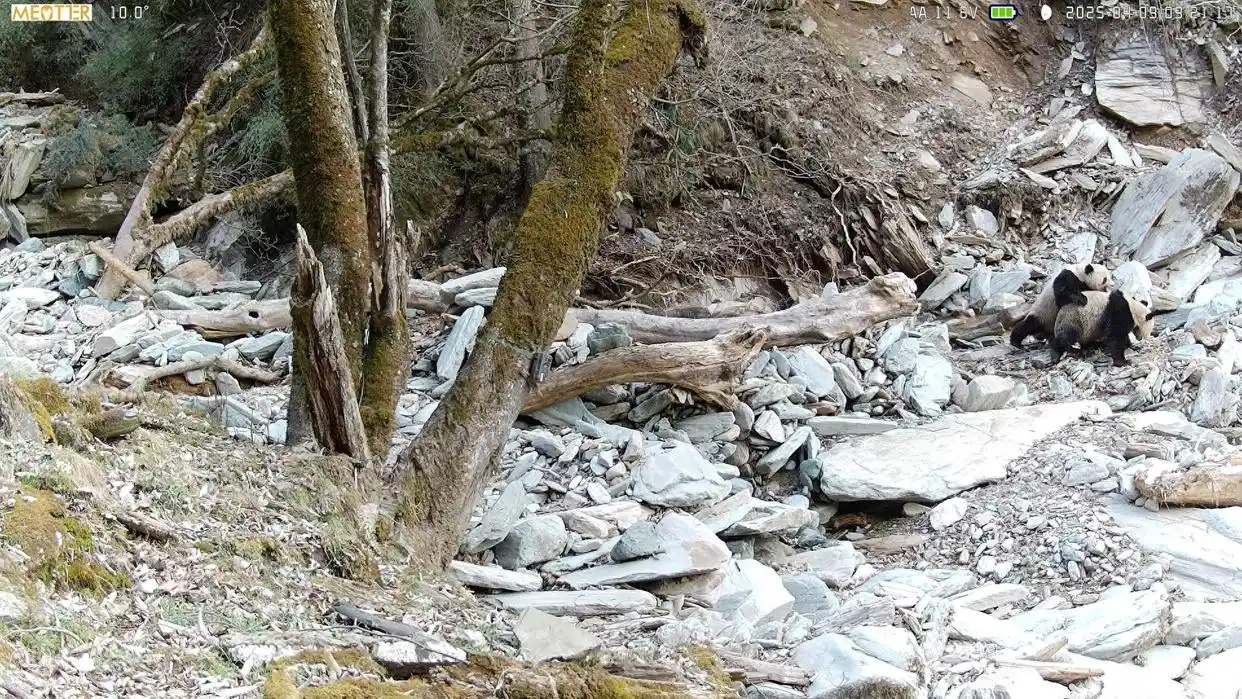
Recently, while reviewing second-quarter infrared camera monitoring data, staff members Li Chenglong and Shen Xingguo from the Motianling Protection Station in the Tangjiahe section of the Giant Panda National Park discovered a rare video: for the first time in 23 years of infrared monitoring, wild giant pandas were successfully captured mating in the wild.
The footage was taken by a camera placed in a mixed coniferous and broadleaf forest at an altitude of 2,280 meters. It was filmed in April, the peak of the giant panda breeding season. The video shows a male panda persistently courting a female who was in the early stages of estrus and displaying typical rejection behavior. The male remained patient, using a strategy of “sniffing–following–gentle nudging,” along with low grunting sounds to signal friendliness. Later, both pandas alternated between making characteristic vocalizations such as “aow-aow” and “woo-woo.”
This sequence of wild courtship and mating behavior captured on camera is a first in Tangjiahe and provides significant scientific value for studying the reproductive biology of giant pandas.
According to reports, in the first half of 2025, researchers in the Tangjiahe section of the Giant Panda National Park collected a record number of observations: 268 video clips of wild panda courtship behavior, 1,015 habitat data entries, 1,799 entries of other animal activity within the same habitat, and 106 instances of panda activity captured by infrared cameras, yielding 392 pieces of footage.
This led to four historic “firsts” in the study of panda population dynamics in Tangjiahe:
- The first time three wild pandas were captured in the same frame.
- The discovery of a second wild panda breeding site in the area.
- The first simultaneous recordings of panda breeding behavior in three areas, including Motianling.
- The first recorded footage of wild panda mating behavior.
In addition, the same infrared camera also captured rare images of other wild animals, including Asiatic black bears and yellow-throated martens. These findings not only offer valuable data for biodiversity research and conservation efforts in the Tangjiahe section of the national park, but also affirm the ecological integrity and conservation success of this key panda habitat.